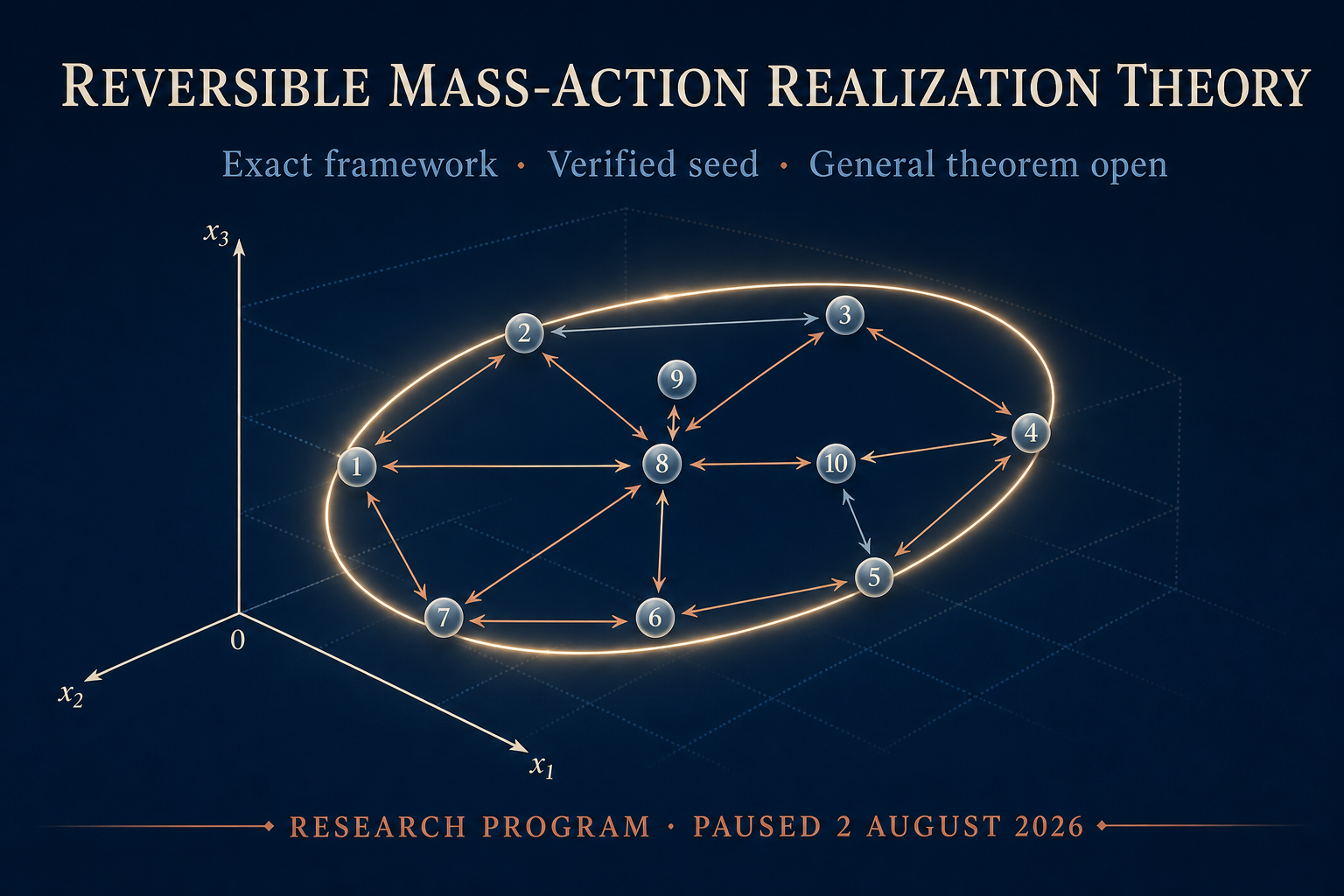
The question, in plain language
When can a prescribed smooth closed curve in the positive concentration region be exactly the equilibrium set of a small reversible chemical reaction network?
The restricted target was a positive ellipse cut out in three variables by one affine-linear equation \(L=0\) and one quadratic equation \(Q=0\). The desired network had to be finite, connected, reversible, full-dimensional in stoichiometry, and equipped with strictly positive rational rates. Its three coordinate polynomials also had to be coprime, while the ellipse appeared as a reduced equilibrium component.
This followed the separate, immutable Version 2 release of A reversible three-species mass-action continuum without a common factor. Nothing in this program changes that earlier result or release.
Important progress preserved
An exact geometric input test
After parametrizing the affine plane as \(x=p+Bu\), the restricted quadratic becomes \(u^{\mathsf T}Au+2b^{\mathsf T}u+c\). Rational inequalities in \(A,b,c,p,\) and \(B\) certify that the conic is a smooth nonempty ellipse and that every point on it lies strictly inside the positive orthant. This separates the geometry of the requested curve from the reaction-network search.
Fixed-support realization becomes linear algebra
Fixed-support theorem. For any chosen reversible support, reduce each unit-rate reaction contribution modulo a Gröbner basis of \((L,Q)\). The resulting rational matrix \(M\) satisfies \[ F_i\in(L,Q)\ \text{for all }i \quad\Longleftrightarrow\quad Mk=0. \] Thus every conic-preserving rate vector on that support is captured by one exact rational kernel.
Strictly positive rates are then an exact cone-feasibility problem: decide whether \(\ker M\) meets the positive orthant. A rational positive point is a direct certificate; a Stiemke-type dual vector is an exact obstruction.
Local algebraic checks after feasibility
Writing each coordinate field as \(F_i=A_iL+B_iQ\) gives a concise reducedness test. If a \(2\times2\) minor of the coefficient matrix \([A\ B]\) is nonzero at a smooth conic point, the localized steady ideal equals \((L,Q)\) there and the Jacobian has rank two. A separate projective argument shows that coordinate coprimality is a Zariski-open condition inside a fixed conic-preserving rate family once one exact coprime witness exists.
A proof-producing search architecture
The framework organizes bounded-support exploration into finite exact stages: graph and stoichiometric filters, construction of \(M\), rational positive-kernel or dual certificates, coordinate gcd checks, local reducedness, and only then saturation or residual-component analysis. The reusable implementation preserves row labels and exact arithmetic for this pipeline.
The independently verified seed
A standalone verifier reconstructs one known positive ellipse and one reversible support from frozen integer data. It imports no code or data from the earlier continuum project.
| Feature | Verified value |
|---|---|
| Network support | 10 complexes and 10 reversible pairs |
| Stoichiometry | Rank 3; one positive compatibility class |
| Remainder matrix | \(21\times20\), rank 16, nullity 4 |
| Positive rate family | A full four-dimensional strict-positive cone |
| Clean integer witness | Parameters \((653,1,70,915)\) |
| Equilibrium curve | Positive rational parametrization; distinct points for \(-1<t<1\) |
| Algebraic checks | Coordinate gcd 1 and Jacobian rank 2 at an exact conic point |
This seed validates the framework’s layers simultaneously in one instance. It does not show that the same support works for a neighboring ellipse, much less for every positive rational ellipse.
Exact claim boundary
- Established: conic preservation on a fixed support is exactly a rational kernel problem.
- Established: strict positive feasibility has exact primal witnesses and dual obstructions.
- Established: the stated local minor condition certifies a reduced conic near a chosen smooth point.
- Established: one ten-complex support realizes one positive ellipse with a four-dimensional positive cone of rates and coprime coordinate fields.
- Not established: persistence for an open family of ellipses, a finite catalog or bounded-degree universal support, or exclusion of all residual positive-dimensional steady components.
Why the program is paused
The foundational reductions succeeded, but the central leap from one exact seed to a genuine realization theory did not. General affine normalization does not preserve mass-action monomials, positivity of a fixed kernel may change across Gröbner strata, and the local reducedness criterion alone does not control every residual curve elsewhere in the steady-state variety.
Continuing immediately would mean launching broader support enumeration before proving the structural lemmas that could make such a search informative. We are instead freezing the clean checkpoint and producing no manuscript.
If the workstream is ever resumed, the meaningful gates are a compatible normalization theorem, an exact open-region result for the seed support, a support-extension operation, or a local-to-global criterion controlling residual components. More blind graph enumeration by itself is not a resumption criterion.
Inspect and reproduce
The complete checkpoint is small and exact. These are the main entry points:
README.md— objective, paused status, contents, and claim boundary.FRAMEWORK.md— exact reductions, proofs, search architecture, and open gates.verify_seed.py— standalone exact reconstruction and verification of the seed.remainder_map.py— reusable fixed-support remainder-map implementation.RESEARCH_LOG.md— timestamped program opening, verified checkpoint, claim boundaries, and pause decision.
The verifier uses exact integer and rational arithmetic through SymPy. Its final status line is PASS: standalone realization-theory seed verification succeeded.
Scope and AI-assistance disclosure
This page is a research checkpoint, not a paper or a claim of a general theorem. The exploratory mathematics, proofs, programs, verification, and website were developed with heavy assistance from OpenAI Codex under Alec Kriebel's direction. The work has not been peer reviewed.